

LCM Calculator: Solve It in Seconds, Then Check by Hand
You’re adding 5/12 and 7/18, and the denominators don’t match. You could multiply them and work with 216, but then you’ll spend another two minutes shrinking a big fraction back down. There’s a smaller number that does the job, and an LCM calculator finds it in a second.
The least common multiple (LCM) of two or more numbers is the smallest positive number that all of them divide into evenly. For 12 and 18, it’s 36. To find it fast, enter your numbers in the LCM calculator. For two numbers by hand, multiply them and divide by their greatest common factor (GCF).
How does an LCM calculator work?
An LCM calculator takes two or more whole numbers and returns the smallest number they all divide into. Most tools use one of two tricks. Some find the GCF first, then apply LCM(a, b) = |a × b| ÷ GCF(a, b). Others break each number into prime factors. CalculatorSoup’s tool goes further and can show the working with listed multiples, prime factorization, the ladder method, the division method, the GCF formula or a Venn diagram.
For three or more numbers, the calculator repeats the job. It finds the LCM of the first two, then the LCM of that answer and the next number. In maths terms, LCM(a, b, c) = LCM(LCM(a, b), c).
Know the limits before you trust any tool. They’re built for integers. Alcula’s calculator, for example, takes two to ten numbers, each between -2,147,483,648 and 2,147,483,647. Zero is another trap. By definition, the LCM of 0 and any number is 0, yet some calculators refuse a zero entry and show an error instead.
What are some LCM examples to check against?
Here are pairs you can test in any LCM calculator. The GCF column helps you spot a pattern: the more two numbers share, the smaller their LCM is compared with their product.
| Numbers | LCM | GCF |
|---|---|---|
| 3 and 5 | 15 | 1 |
| 4 and 6 | 12 | 2 |
| 12 and 18 | 36 | 6 |
| 14 and 21 | 42 | 7 |
| 45 and 60 | 180 | 15 |
Sets of three work the same way. LCM(4, 6, 10) is 60, LCM(8, 9, 21) is 504, and LCM(12, 16, 21) is 336. Every figure in this article was also checked with a script, so you can copy them safely.
Two shortcuts are worth remembering. When two numbers share no factor, like 3 and 5, the LCM is just their product. When one number divides the other, like 4 and 12, the LCM is the bigger number.
How do you find the LCM by hand?
Pick one method and learn it well, then use the calculator to check yourself. If you only trust the tool, you won’t spot it when you type a number wrong.
Method 1: List the multiples
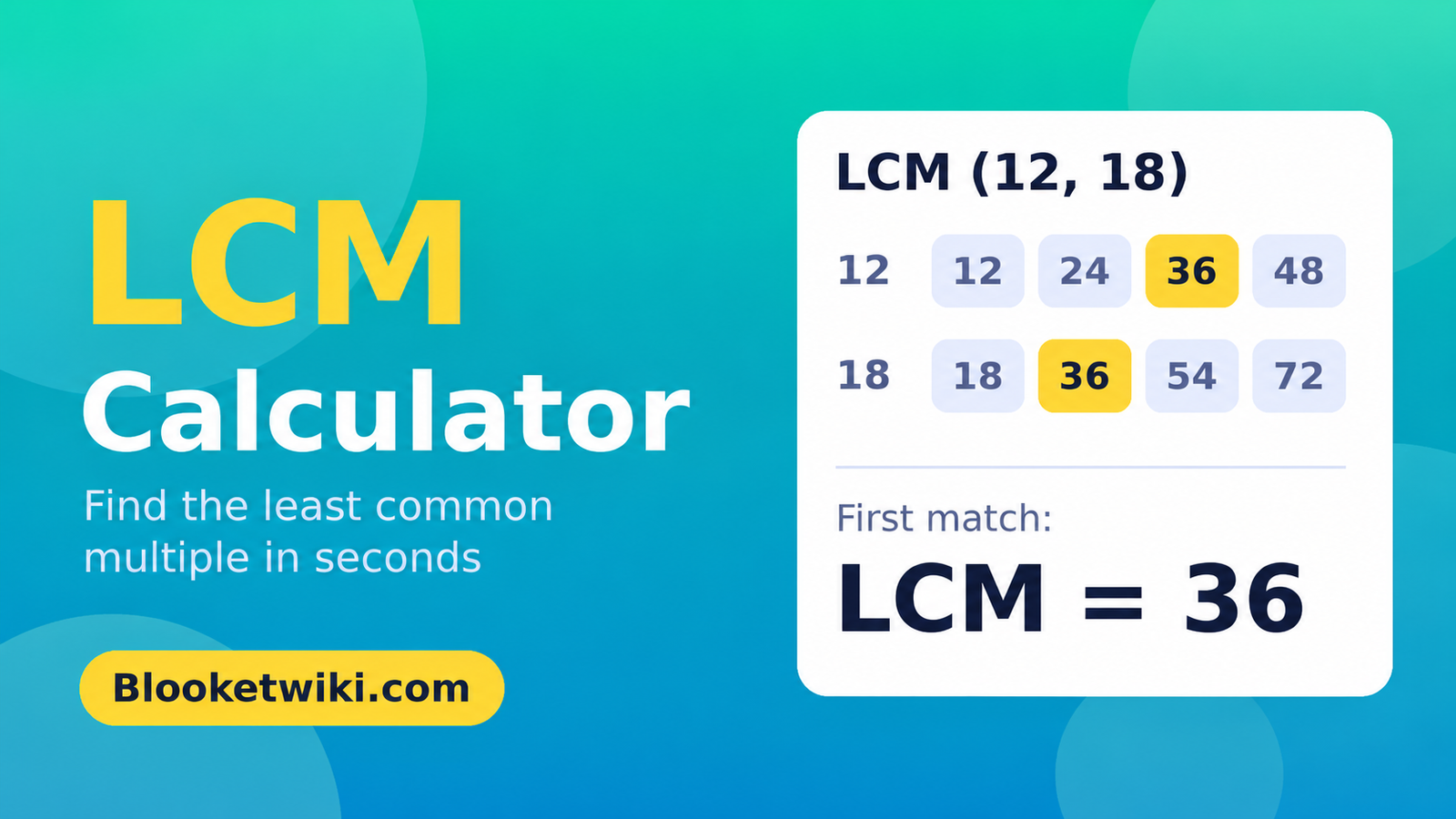
Write out the multiples of each number until one appears on every list. For 12 and 18, the multiples of 12 are 12, 24, 36, 48. The multiples of 18 are 18, 36, 54. The first match is 36.
This is fine for small numbers. It gets slow fast, though. For 45 and 60 you’d need to list out to 180.
Method 2: Prime factorization
Break each number into primes, then keep the highest power of every prime you see. Take 18, 24 and 30:
- 18 = 2 × 3²
- 24 = 2³ × 3
- 30 = 2 × 3 × 5
The highest powers are 2³, 3² and 5. Multiply them: 8 × 9 × 5 = 360.
Why the highest power? The LCM has to be a multiple of every number on your list, so it needs enough of each prime to cover the number that uses the most. And a prime that shows up in only one number, like the 5 here, still goes in at full strength. Drop it and 360 would no longer be a multiple of 30.
Method 3: The GCF formula (two numbers only)
For two numbers, LCM = (a × b) ÷ GCF. Take 18 and 24. Their GCF is 6, and 18 × 24 = 432, so the LCM is 432 ÷ 6 = 72.
Don’t stretch this to three numbers. Try it on 4, 6 and 8: the product is 192, the GCF of all three is 2, and 192 ÷ 2 gives 96. The real LCM is 24. Chain the pairs instead. LCM(4, 6) = 12, then LCM(12, 8) = 24.
Method 4: The ladder (cake) method
This one is quick when you have three or more numbers. Write them in a row. Divide by any prime that goes into at least two of them, bring down the results, and repeat until no prime divides two numbers.
For 12, 18 and 30, divide by 2 to get 6, 9, 15. Divide by 3 to get 2, 3, 5. No prime goes into two of those, so you stop. Multiply the divisors and the bottom row: 2 × 3 × 2 × 3 × 5 = 180.
My pick: prime factorization for exams, because teachers can see your working, and the ladder for speed.
Where would you use the LCM in real life?
The most common use is adding or subtracting fractions. Back to 5/12 + 7/18. The LCM of 12 and 18 is 36, so you rewrite the fractions as 15/36 and 14/36 and get 29/36. Using 216 instead gives 174/216, which still needs reducing by 6. When the LCM is used this way, it’s called the least common denominator (LCD).
Scheduling is the other classic. Say one bus leaves every 12 minutes and another every 18 minutes, and both leave at 9:00. They’ll leave together again at 9:36, because 36 is the LCM.
Engineers use the same idea with toothed gears, as Omni Calculator points out. A 12-tooth gear meshing with an 18-tooth gear brings the same two teeth together again after 36 teeth have passed.
What’s the difference between LCM and GCF (HCF)?
The LCM is the smallest number that both of your numbers divide into. The GCF is the largest number that divides into both. For 12 and 18, the LCM is 36 and the GCF is 6.
You’ll see GCF called HCF (highest common factor) or GCD (greatest common divisor) in different textbooks. They all mean the same thing. If a calculator has an “HCF” button and your book says “GCF”, you’re in the right place.
For two numbers, there’s a neat check: LCM × GCF = a × b. Here, 36 × 6 = 216, and 12 × 18 = 216.
What mistakes should you avoid?
The biggest one is assuming the LCM is always the product. It’s only the product when the numbers share no factor. For 12 and 18 the product is 216, but the LCM is 36.
The second is using product ÷ GCF on three numbers, as shown above. The third is dropping a prime because it appears in just one number.
Typing is a quieter problem. CalculatorSoup tells you to enter 2500, not 2,500, because commas are used to separate numbers. A comma inside a number can be read as two separate numbers.
Finally, don’t panic when the answer is huge. LCMs grow quickly. The LCM of 1 to 10 is 2,520, and the LCM of 1 to 20 is 232,792,560.
Can an LCM calculator handle decimals?
Most are built for whole numbers, but there’s a workaround that CalculatorSoup describes. Count the decimal places in the number that has the most. Shift every number that many places to the right so they all become integers. Find the LCM, then shift the decimal back.
For 0.6 and 0.45, the most decimal places is two. That gives 60 and 45, and their LCM is 180. Shift back two places and you get 1.8. Check it: 1.8 ÷ 0.6 = 3 and 1.8 ÷ 0.45 = 4, so both go in evenly.
LCM calculator FAQs
What is the LCM of 12 and 18?
The LCM of 12 and 18 is 36. It’s the smallest number both divide into evenly: 12 goes into 36 three times, and 18 goes in twice.
How do you find the LCM of three numbers?
Find the LCM of the first two numbers, then find the LCM of that result and the third. For 4, 6 and 10, LCM(4, 6) = 12, and LCM(12, 10) = 60.
Can the LCM be one of the numbers you started with?
Yes. When the largest number is a multiple of all the others, it is the LCM. The LCM of 4 and 12 is 12.
Is the LCM the same as the LCD?
Not quite. The LCD (least common denominator) is the LCM of the denominators in a set of fractions. For 5/12 and 7/18, it’s the LCM of 12 and 18, which is 36.
What is the LCM of a number and 0?
It’s 0, because 0 is a multiple of every integer. Many online calculators reject a zero input, so an error message doesn’t mean you did anything wrong.
Can the LCM be smaller than my numbers?
No. For positive whole numbers, the LCM is always at least as big as the largest number in your set.
Your next step
Pick two numbers from your homework or your fraction problem and run them through the LCM calculator. Then check the answer by hand with prime factors. Doing it both ways once is what makes the method stick.